
AFRA WORKS PROJECT · IN TESTING
Pocket Plan: from everyday requests to an editable plan.
Pocket Plan is an AI organiser developed by Afra Works, currently in testing. It turns everyday requests and follow-up corrections into editable tasks, appointments and routines, with review before saving.
It is being developed for individual planning and team workflows, bringing requests, dates and commitments into a clearer plan.
- Project
- AI organiser
- Focus
- AI integration, product development, user experience and testing
The organising problem
Pocket Plan began with Mo’s own planning needs: capturing informal reminders, keeping dates and details attached to the right item, and making corrections without starting again.
Afra’s aim is a clearer path from an everyday request to a plan someone can review, edit and use.
What the AI prototype does
The tested AI application supports:
- Conversational capture of tasks, appointments, shopping items and routines.
- Follow-up corrections, choices about existing items and inline editing.
- Planned dates and separate deadlines, recurring schedules and skipping or restoring individual sessions.
- Completion, saved drafts, filters and a calendar.
- Review before saving. Plans stay in the current browser.
Exploring the interface
Afra also explored Today, My plan and day/week/month calendars in a separate interface demonstration, v1.0.0. Capture uses local demonstration interpretation. This interface has not been integrated with the AI application.
The design keeps planned work and deadlines distinct, makes undated tasks visible, and lets one routine session be skipped while the others remain.
Separate interface demonstration · v1.0.0
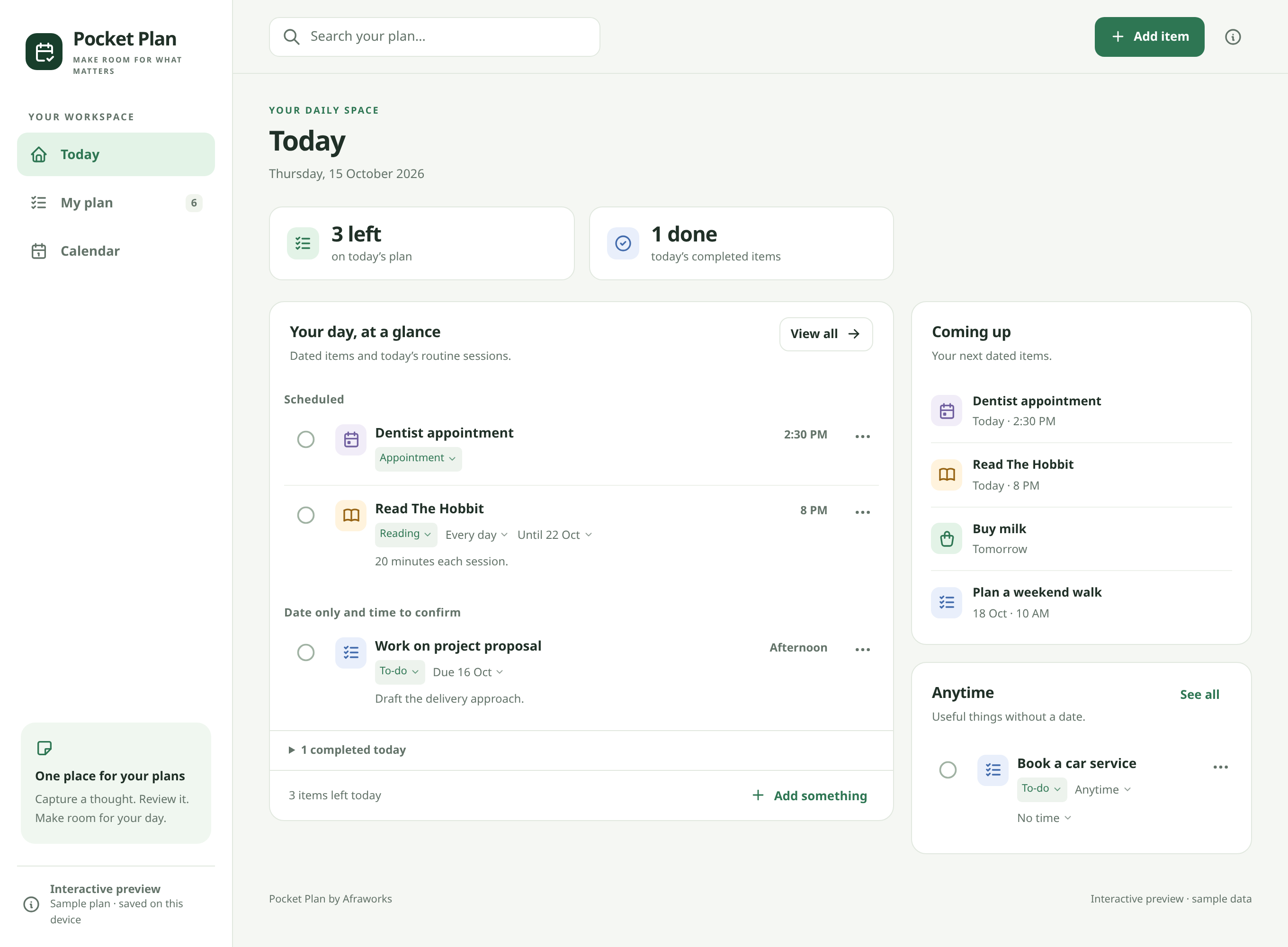
Today groups scheduled items, an afternoon task and undated tasks, alongside completion and upcoming plans. Demonstration data.
Capture uses local demonstration interpretation. This interface has not been integrated with the AI application.
Enlarge Today image
Separate interface demonstration · v1.0.0
Today groups scheduled items, an afternoon task and undated tasks, alongside completion and upcoming plans. Demonstration data.
Capture uses local demonstration interpretation. This interface has not been integrated with the AI application.
At full size, scroll or use the arrow keys to explore the image. Press Escape to close.
Separate interface demonstration · v1.0.0
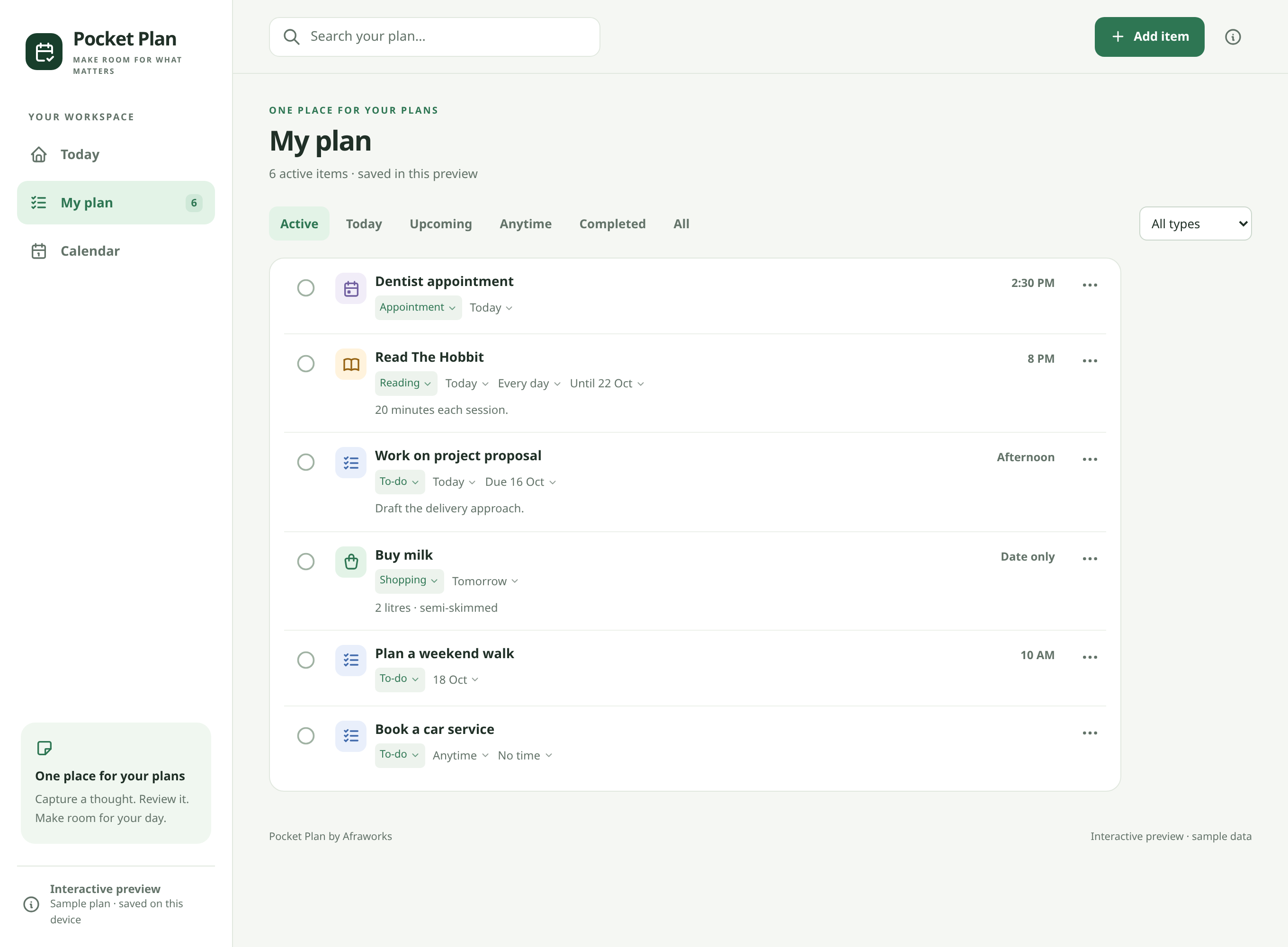
My plan keeps scheduled items, a separate deadline, recurring reading and an undated task together. Demonstration data.
Capture uses local demonstration interpretation. This interface has not been integrated with the AI application.
Enlarge My plan image
Separate interface demonstration · v1.0.0
My plan keeps scheduled items, a separate deadline, recurring reading and an undated task together. Demonstration data.
Capture uses local demonstration interpretation. This interface has not been integrated with the AI application.
At full size, scroll or use the arrow keys to explore the image. Press Escape to close.
Separate interface demonstration · v1.0.0
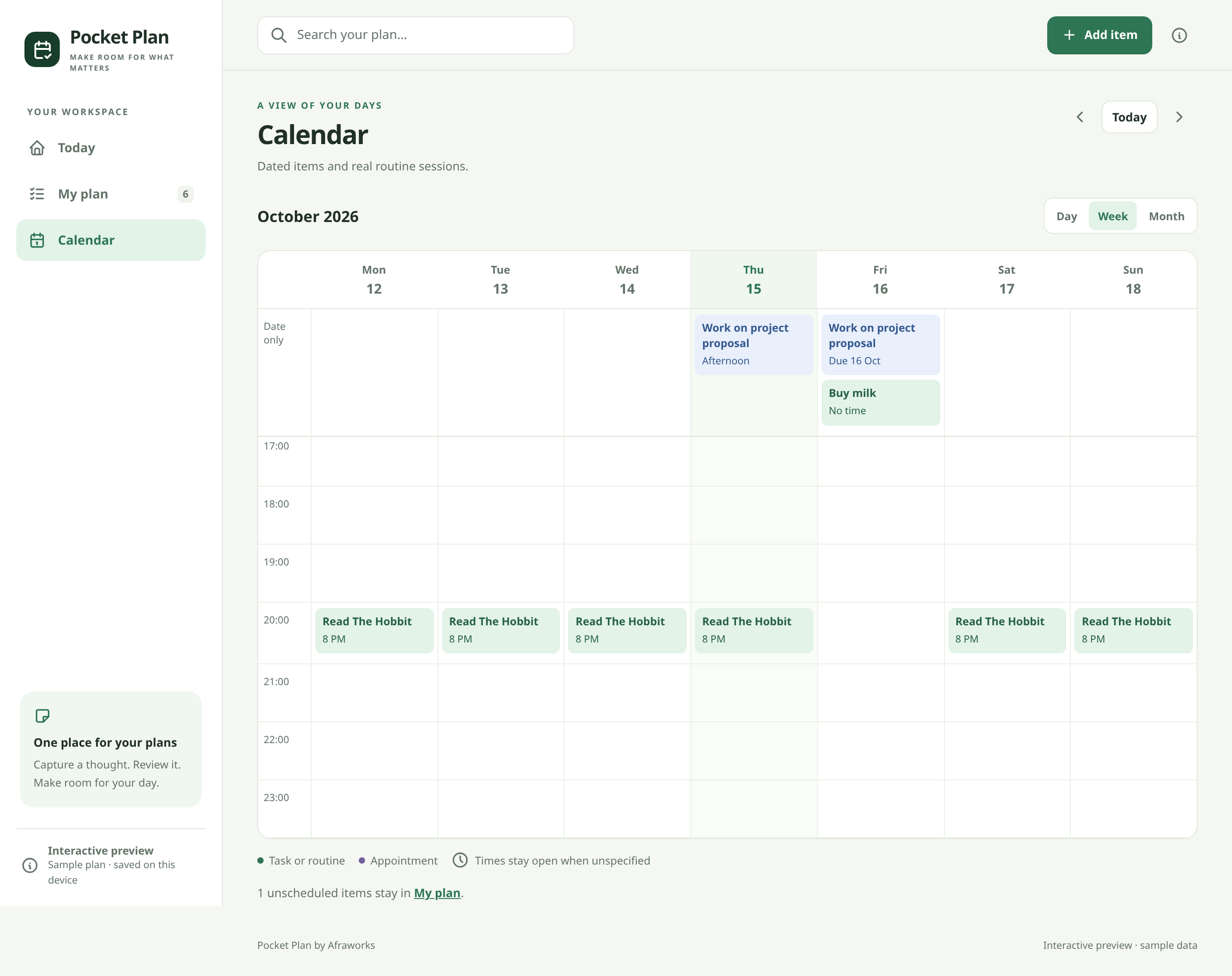
Week view shows Friday 16 October’s reading session skipped, while neighbouring sessions and the proposal deadline remain. Demonstration data.
Capture uses local demonstration interpretation. This interface has not been integrated with the AI application.
Enlarge Calendar skip image
Separate interface demonstration · v1.0.0
Week view shows Friday 16 October’s reading session skipped, while neighbouring sessions and the proposal deadline remain. Demonstration data.
Capture uses local demonstration interpretation. This interface has not been integrated with the AI application.
At full size, scroll or use the arrow keys to explore the image. Press Escape to close.
A correction that keeps the right item
This recorded test used Friday 9 October 2026 as its reference date, in Europe/London.
- The request “Edinburgh planning” produced an undated To-do, with time unset. The item was saved.
- After a reload, the follow-up was “Actually, Sunday instead.”
- The correction selected the same item and proposed Sunday 11 October 2026. The time stayed unset.
- After saving and reloading again, the change persisted. The five other synthetic items were unchanged.
This demonstrates context and item selection in one defined interaction.
The image below replays the recorded release-29 application responses and shows the correction awaiting Save. It is not a fresh AI call.
Recorded live AI test replay · Release 29
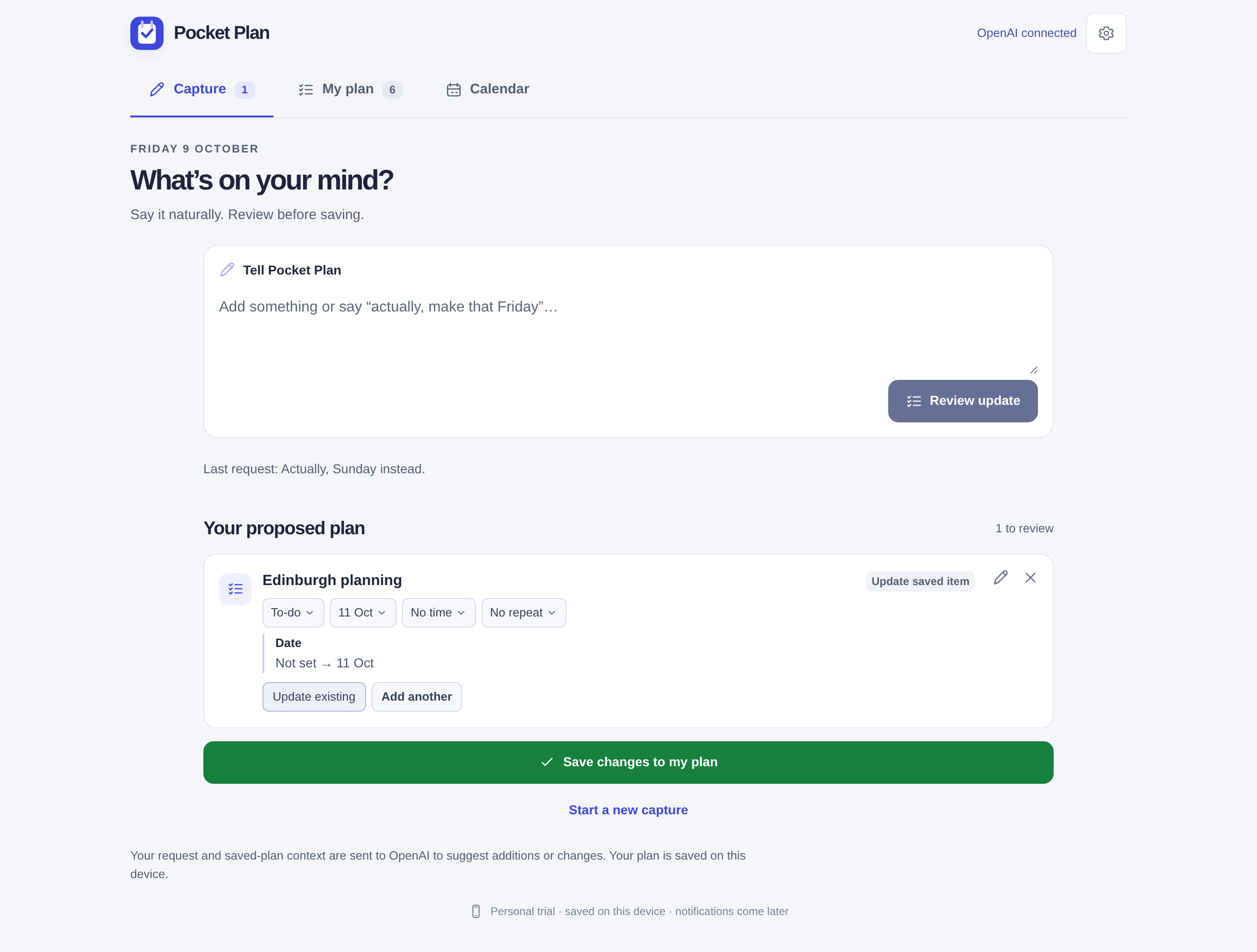
Recorded live AI test replay, release 29. Edinburgh planning is proposed for 11 October 2026, with time unset. Demonstration data.
Enlarge Recorded correction replay image
Recorded live AI test replay · Release 29
Recorded live AI test replay, release 29. Edinburgh planning is proposed for 11 October 2026, with time unset. Demonstration data.
The image below replays the recorded release-29 application responses and shows the correction awaiting Save. It is not a fresh AI call.
At full size, scroll or use the arrow keys to explore the image. Press Escape to close.
Development and technology
Afra Works developed Pocket Plan under Mo Jazini’s direction. Mo defined the requirements, set the user experience priorities, directed development and tested realistic conversations and mobile use.
The working AI prototype uses an OpenAI model through the Responses API to interpret requests and follow-up corrections. Application checks validate proposed changes before the user reviews and saves them.
Codex supported implementation, debugging, testing and deployment.
Development checks focused on whether corrections selected the right item, preserved unrelated details and survived saving and reloading. Earlier failed runs remain in the record and informed further fixes.
Testing notes
Evidence: AI application release 29; interface demonstration v1.0.0
| Version and recorded checks | Scope |
|---|---|
| Release 29: 151 automated checks | Application rules, including item identity, recurrence, field preservation and saving. API checks use simulated provider responses. |
| Release 29: 36 browser scenarios | Actions, storage, reload and calendar behaviour, using simulated provider responses. |
| Release 29: 10/10 recorded live AI conversation runs | Targeted additions, corrections, saved-item and pending-change checks across six scripts and 16 API requests, including repeated runs. |
| Interface demonstration v1.0.0: 14 local interaction checks | Editing, review/save, recurrence exceptions, completion, Undo and calendar behaviour. Additional layout checks covered 1440, 390 and 320px widths. These made no live AI calls. |
The counts describe specified workflows and small, targeted conversation samples. They do not establish a general accuracy rate or complete native iPhone validation.
Current stage
Pocket Plan is a working prototype in testing. The AI application and redesigned interface are currently separate. Integration and wider device validation remain unfinished. Notifications, Apple Calendar and Reminders integration, and cross-device synchronisation are planned.
Applying the approach to business work
Pocket Plan shows Afra’s approach to defining workflows, integrating AI and keeping proposed changes open to review.
For a business task involving repeated requests, information updates or manual entry, Afra can help assess the problem and define a useful starting point.
Back to selected work